Sunday, 6 March 2011

Design Safari


Ethnography.


The Ethnography Primer describes ethnography as a research method based on observing people in their natural environment rather than in a formal research setting.

This method is commonly used in design as it creates a deeper understanding of people. It can be used to make sense of different cultures, understand norms and communicate information in ways that are easily comprehendible to people.

Understanding clients or potential markets are key in creating a successful product.


The Importance of Rules.

Bourdieu gives a good example of how people avoid situations, which could make them uncomfortable, as they are not familiar with the social codes or “rules” associated with that particular situation. He states that galleries and museums are places that ‘ordinary’ people are put of going to as they feel there is a stereotypical type of person who attends such places and they themselves do not fit in that category. Although ‘ordinary’ people could go to such places, they assume they would not fit in or know how to act.


Observe and Record.

To test both Ethnography and Bourdieu’s theory, we were asked to put ourselves in a situation we were not used to, identify any “rules” and assess how we feel. We were also asked to visit places such as supermarkets to observe people going about their daily business…


Primary Site: The Casino.

Preconceptions:

Having never been to a casino before I was expecting a very busy and loud atmosphere, Las Vegas style! I anticipated that there would be a very strict dress code and that almost all of the people attending would be fairly wealthy. I expected to feel very out of place being a young student and didn't imagine anyone of similar age to myself would be there. I pictured the casino to be a very grand place and that I would have to behave in a very formal fashion.

How I felt:

Once inside the casino I initially felt very intimidated when becoming a member. I felt embarrassed being so young when I handed over my ID and was concerned about being judged. I felt particularly awkward when posing for a photograph by myself.
Once up the stairs I was surprised by the way what other people were wearing and suddenly felt a little over dressed! People were dressed smart but not as extravagantly as I was lead to believe.
I was also surprised by the relaxed atmosphere around the bar area where I decided to stand, not having a clue about gambling... I'm sure I easily stood out as a new comer!

Observations:


After attempting to read people, I put together a quick mind map of my findings...


Conclusion:

After spending a few hours in the casino I began to pick up on the common accepted "rules" and noticed a pattern in how people generally conducted themselves. For example,  it was frowned upon when people reached a level which was considered to intoxicated to stay on the premisses. I witnessed one girl being asked to leave, not noticing myself that she was particularly drunk. It was obvious impeccable behaviour was expected and people were not impressed when others did not conduct themselves in the correct way. Another thing I picked up on was that the "hard core" gamblers were easily recognisable and could be set apart from the "casual" gamblers quickly. Casual gamblers would head straight to the bar in small groups and perhaps played on the slot machines for quite sometime. They appeared relaxed. The more serious gamblers appeared t be in a very intense and focused "bubble" choosing not to socialise too much. When playing the casual gamblers would be talking amongst themselves where as the serious gamblers would be quiet, leaning towards the table appearing very frustrated and slightly aggressive when they lost money, very involved with the game.


Secondary Site: Tesco.

Observations:


I applied the same observations to a supermarket environment...


Conclusion:


There weren't too many surprises when I wandered around Tesco. I was slightly more aware however of how people acted depending on wether or not they were alone, in a group of friends or if they were a family shopping. 
Generally, people by themselves appeared to be very focused with no distractions. In some cases, people appeared deliberately focused suggesting perhaps they did not enjoy being alone, throwing themselves into the task to distract from the fact they were by themselves. These people seemed to go around the shop in a hurry, obviously limiting the time they were alone. Another explanation for peoples hurried manor could be that they were simply in a rush and chose to go alone for quickness. They could also be shopping quickly to avoid a social interaction which would make them feel uncomfortable, perhaps bumping into someone they knew but did not wish to speak to.
People with young families often appeared stressed having children in public for any length of time with their unpredictable behaviour. Some parents also seemed embarrassed when this unpredictable behaviour took a turn for the worse. Other customers tended to avoid aisles where a parents body language suggested they were angry with their child and did not want to be involved. Some parents could be overly defensive if someone looked at them while they were giving their children a row. Perhaps putting on a front so they did not give away their embarrassment.
Young people in groups of friends on the other hand were much more relaxed and tended to wander around the shop without appearing to have anything in particular to buy. I noticed this laid back approach to shopping could annoy customers who were perhaps in a hurry and needed those around them to speed up!
Shopping can obviously be a very different experience for various people. Some people treating the experience as a chore and others as a more sociable event.

Saturday, 5 March 2011

Service Design Tools


 The website “servicedesigntools.org” provides a comprehensive list of many tools which are useful within the design process. Although the tools stated are given in the context of service design they can be related and used in various other disciplines.

 The “Storyboard Tool” page offers a collection of case studies showing how this tool can be applied in service design research.

A storyboard is used within service design to map touch points and their relationship between them and users in the given experience.


One case study, The Handy Man Shop, François Jégou, Ezio Manzini (Sustainable everyday project), demonstrates how a storyboard can be used to portray different scenarios within a shop and proposed solutions.


Note: The above example uses a clever and simple orange barrier to separate each scene!


This technique could be directly applied to the Interiors design process. Storyboards are a great way of communicating how a space is occupied or for example, how a person would move through a space. The storyboard tool could be used in both the research and final proposal stages of creating a space. They could show the current uses of the existing space during a renovation project at the new proposed use of the space at the end of a project. The use of storyboards at the final proposal stage would be arguably the most relevant as it is essential to portray to clients how users will enter a space, which rooms they arrive at first and the general layout of the building in context.

I once used this technique in a commemorative space project in first year. I used simple line drawings in sequence to demonstrate how the monument was viewed from different positions around the site.

The tool would definitely be useful in my current project, designing a business hub, as in particular I am looking at the way users move through the building and what areas need to be linked to one another. The order in which people enter each space in this project could be clearly shown through the use of a simple tool such as a storyboard! 

Wednesday, 2 March 2011

Bone Appetit!

When doing research on Celebration, Florida - the master-planned community created by the Disney company - after the lecture on Disneyfication, I decided to look at what businesses were in the town. Aside from your average restaurants, Starbucks, art shops and clothing stores, etc, I stumbled upon this:


While, after looking further into the company, it becomes clear that it's not just yet another average pet shop, in the vein of Pets at Home, and it also has probably one of the best names for a company, I've ever heard, for a pet food company or otherwise!


You could say it probably specialises in making more appealing dog treats than you'd get in an average supermarket, with its website saying it makes "hand-made, gourmet dog treats... baked using fresh, wholesome ingredients," which would probably make it popular among people who would wish their dogs to be eating more healthily. So popular, in fact, that in Florida alone, there's 15 Woof Gang Bakery franchises, with two in North Carolina, one in Texas and one in Georgia. 


Another happy customer...


If you ever want the chance to run your own Woof Gang Bakery (me and Darren laughed at the name and website for nearly 15 minutes), here's your chance! Woof Gang Bakery - Franchise Q and A! 


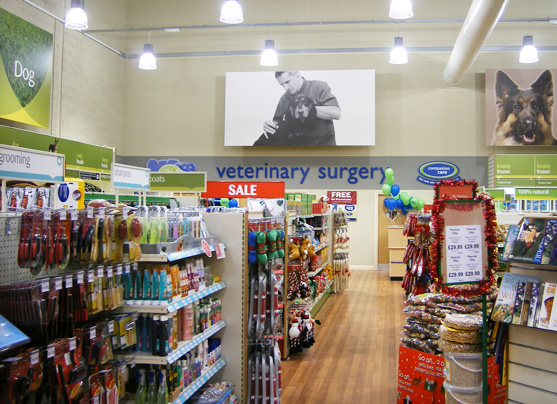
With the store in Celebration looking like more of a dining room than a shop due to the minimal shelf space used, plates of treats being instead placed on top of an elaborate table, and with the store lit by two chandeliers that wouldn't look out of place in a grand hotel lobby, the store immediately sets itself apart from its competitors that are often designed very much like a supermarket. See below for a typical design of a Pets at Home store:


Note the heavy use of artificial light in the large space, with a heavy focus on shelving, which is tailored towards functionality as opposed to aesthetics.

There's an International Development page as well that's under construction, so you never know, you might not need to go to America to pick up some fancy dog treats! You know, it's food for thought...

Monday, 21 February 2011

Assignment 2


Assignment 2 of the second semester saw us looking at the term “Polysemy” and Roland Barthes “The Rhetoric Of The Image”.

“Polysemy” refers to a word with two or more similar meanings.  For example,
The man stood is at the foot of the mountain.
He bent over to tie his shoe on his left foot.
In the first sentence, “foot” refers to the area around the bottom of a mountain. In the second sentence the same word refers to the body.

By the same token, in the context of an image or photograph, “polysemy” simply means to derive meaning from.

When presented with exactly the same image, two people could get two very different meanings.

Take a look at the three images below. What story do they tell you?


When I first looked at the three pictures I decided that they suggested a broken relationship, which was beyond repair  (the dry, cracked ground). I thought perhaps one party had left (the car facing away from the viewer) and that over time the other party had become depressed and turned to alcoholism (the bottles sitting next to the clock).

An example of how different people relate to different images in very different ways is shown here when I asked a 21 year old female from Edinburgh, studying Psychology to look at the images.

“Two people were stuck in a desert because they ran out of petrol. They had no food or water for days and began to loose hope. When eventually someone came to their rescue they celebrated by going to the pub.”

After repeating the experiment on multiple people, it became apparent that something was changing the outcome each time. If the images were not the variable, could it be that each person’s individual background, knowledge and experiences influenced how they interpreted these images? This idea posed many questions. What other factors could colour people’s perception? Mood? Social group?

“The Rhetoric of the Image” by Roland Barthes supports this idea. Barthes suggests that messages people take from images can be grouped into three different types.

1.     The non-encoded iconic or Clear meaning – Common understanding that is apparent to everyone.
2.     The coded iconic or Symbolic meaning – Understanding from relating an image with personal cultural knowledge.

3.     The linguistic or Textual meaning. – Understanding of image after reading included text.

It’s number two, The Coded Iconic, which shows how each person interoperates each image in a unique way. For example, you may relate the images to a subject you studied at university. Someone studying Interior and Environmental Design may look at these images and focus on the colours used and incorporate this in their story.

The Linguistic, number three, suggests that text can be used to change the meaning people derive from any given image.

To show this I added the word “love” to one of my images and repeated the experiment again asking a different group of people.

This time, 19 year old Chris from Fife who works at Debenhams said…

“A lone wanderer travels the rustic roads of the south, dreaming of his college sweetheart when distracted he crashes deep within the forest. For days he was alone and stranded. Isolation made him crazy and when he eventually returns home he turns to alcoholism to numb his pane.”

The addition of the word love has evidently encouraged the theme of romance, in this case it provided a reason for the man to crash and suggests his loneliness.

A simple word can completely change the meaning of an image and could be used to lead views down a specific path. Barthes example given in his paper shows how this relationship between text and image can be a powerful tool in advertising. Perhaps we are under a greater influence into what we buy or where we eat than we realise!


As we worked in groups to collect evidence we accumulated a few stories. Here’s a look at some of the other responses:

Kirsty
20 years of age
works at call center

Shown: car, bottles, mud with the word Love.

“These pictures symbolic the idea of loving the earth, for example, to banish pollutants from cars and stop littering.”


George
(Student) chemical engineer

Shown: Cracked mud, Car, Bottles

“The scenario is a person who drink drives and as a result, dies.”


Laura
Student (studying English)
18 years old

Shown - cracked ground, car, bottles.

“There was a drought. 2 people travel by car to help by taking water to the people affected.”


Sandra
40+
Manager

Shown - bottles, cracked ground, car.

“There is conflict between a couple. The cracks in the foundation of their relationship are too deep and one of them leaves.”


Images:

Thursday, 3 February 2011

1D: The Johari Window

After completing this assignment we were asked to look up "The Johari Window" and comment on how it explains our our reaction to our partners perceptions of our personality. 

Created in 1955 by Joseph Luft and Harry Ingham, A Johari Window is a reflective tool used to help people understand their communication and relationships with others.

The person is given a list of 56 adjectives and encouraged to pick five or six that they feel describe their own personality best. Friends or colleagues of the person are then given the same list, and each picks five or six adjectives that they feel best describe that person. These adjectives are then placed strategically onto a grid by each person.

The grid is also known as The Johari House with four rooms. Room 1 is the part of us that is known to ourselves and others. Room 2 is the aspects that are known to others but not ourselves. Room 3 is the part of us which is seen by neither ourselves or by others. Room 4 is our private space, which we know about but choose to keep from others.


Below is an example table using all the 56 adjectives which I have placed in a rough order to suit myself.


After asking friends if there was anything they knew about me which I had marked down as "unknown to others", the window showed that there are aspects of my personality which I did not think were visible to others, when in fact they were. Adjectives which I would class as "known to me" but not "known to others" are often known to others through their perception of clues subconsciously given away through what I own, wear, go etc. This supports the idea that your 'stuff' really can say a lot about you!

Reactions To 1B and 1C.

So here’s what my partner thought of my perceptions of her:

“Spot on! Although I've actually never been told that I'm really girly before, I guess I do like my room to be 'cute' and homely, but I don't think my personality is obviously girly. I live with 3 other girls and I'm from Glasgow so I do live away from home”

It just goes to show you can tell a lot about a person from their possessions and how they inhabit their personal space!

I have to say, my partner did a very good job of analysing my room. I would agree with everything she said about my habits and personality. The only mistake she made was assuming I lived with my parents when in fact I live in a flat with three other female students.

Below are pictures I sent to my partner and what conclusions she drew from them!


"I'm thinking you live at home with your parents cause there's no skint student vibe about your room? haha, the furniture is really nice and new. Pretty homely looking, unless you've got a beast of a flat in Dundee.

Your bedroom was really clean and tidy! duvet proper tucked in, pillows placed and not just flung down. I think maybe you're a really organised person, that you like to have everything planned and feel in control of things..from the decor/bed clothes/ballet shoes/book on fashion I get the vibe you like your girly things?

The desk was really neat and in order too, I get the impression you're really into what you do at school, always make deadlines, get stuck into the work and enjoy it? 

You're into the old school Disney films and your little Henry and Hetty hoovers give me the vibe you're quite a bubbly person/doesn't take things too seriously...

You've got quite a Twilight collection, are you into vampires? haha. So you're probably in love with Edward Cullen, me too!

Friends boxset and quizzz, you've probably got a pretty good sense of humour! chipmonkss/meerkat teddy/mini hoovers..a quirky, fun, you enjoy a laugh and probably a good bev am I right?


It’s a rather strange feeling having someone that you don’t know pick through your stuff looking for clues as to what kind of person you may be!

Wednesday, 2 February 2011

Assignments 1B and 1C of the new semester!

For this assignment we had to apply Sam Gosling’s Snoop Theory to a partner’s belongings and decide what we believed their personality, tastes and influences were.


From what I can gather my partner lives away from home to with possibly one or two other girls? No boyish vibes about the flat!

The pink colour scheme and floral bunting in her room would suggest she is a very 'girly girl'?

I'm guessing that she is not a messy person but definitely not as fanatic as I am about organization. A couple of things were lying around her room and the bottom of her wardrobe seemed to be a place to put anything which didn’t have a specific home of it’s own. Quite a relaxed, laid back person? I did notice however that her shoes were very organised in the wardrobe so I'm guessing she takes pride in them and loves shoes? I liked how they were paired and all facing the front! A lot of thought put into how they are displayed. Also the Topshop shoebox on a shelf elsewhere in her room suggests shoes are something she is prepared to spend money on.

She appeared to be a very sentimental person, keeping concert tickets, photographs with friends and some photographs from her childhood. From her pictures with her friends I assumed she is a fun and outgoing person as she is smiling and laughing in most of them. This suggests she is the type of person who is always up for a laugh. Perhaps the odd drink with friends judging by the Jagermeister bottle she kept as a memento.

From various images on her wall I could tell she was interested in photography and graphics, maybe a bit of collage? Definitely arty. Lots of colour!

Robert Pattinson fan judging by the poster and supported by the Twilight book and film!

Could Bambi be her favourite Disney film? There were a couple of images on her wall.

From the nail varnish and tweezers I'm guessing she takes pride in her appearance? Make-up bag and various hair products would suggest this too.

By displaying personal belongings, for example on her windowsill, she perhaps likes to customise her space and make it her own? Photos and images on the walls suggest she likes to make things homely.

A watch similar to the style of products sold at shops such as Urban Outfitters suggests she have a keen interest in fashion? In particular is she influenced by reto styles? The watch is a traditional Casio model.

Again, candles, doll, My Little Ponies and ice-cream cones also suggest she is a very feminine girl. The ponies give the impression she does not shy away from her youth.

Her DVD collection appears to be quite small suggesting she would rather have a night out than a night in? Also the majority of DVD's are comedy. This may be something she enjoys.

I picked up on a diverse taste in music. Not a specific taste as she has a Jay-Z poster, and in contrast, a ticket from a Frightened Rabbit concert.


I wonder what I got right…